FaceLog
FaceLog is a facial recognition logging system designed to automatically track student activity within laboratory environments.
The system continuously processes camera feeds to identify users, record their entry and exit times, and maintain a real-time activity log without requiring manual attendance tracking.
This project combines computer vision, machine learning, and distributed systems to build an automated monitoring platform.

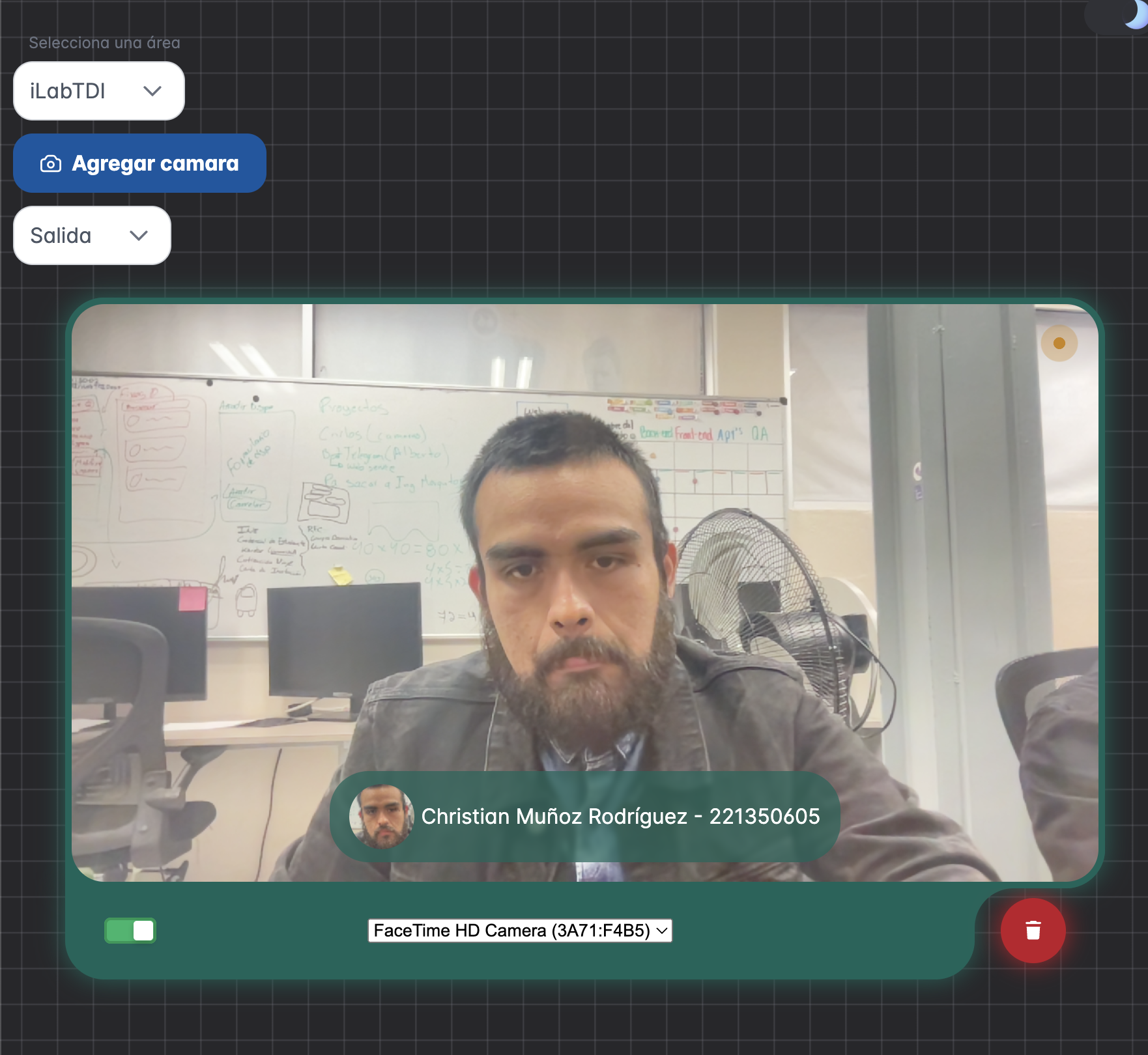
What This Documentation Covers
This section describes the technical design and internal operation of FaceLog.
The documentation is divided into several parts:
- Recognition Process — How the system detects and identifies faces.
- Mathematical Model — The mathematical principles behind the recognition pipeline.
- Architecture — The distributed system design and infrastructure.
- Tech Stack — Technologies used to build the system.
- Usage — Basic instructions for operating the system.
Each section focuses on a specific part of the system to make the documentation easier to explore.
System Goals
FaceLog was designed with the following objectives:
- Automate attendance logging using facial recognition
- Monitor laboratory activity in real time
- Identify both registered and unknown users
- Maintain a persistent activity log
- Provide administrators with tools for manual corrections
Core Technologies
The system is built using a combination of technologies across several domains:
- Computer Vision for face detection
- Deep Learning for identity recognition
- Distributed Infrastructure using containerized services
- Web Applications for monitoring and administration
Explore the Documentation
To understand how the system works, start with the following sections:
- Recognition Process
- Architecture
- Mathematical Model
- Tech Stack
- System Usage
Together, these pages describe how FaceLog was designed and implemented.
📄️ Recognition Pipeline
The facial recognition process in FaceLog follows a structured pipeline designed to detect, analyze, and identify faces captured by camera devices.
📄️ Mathematical Model
The FaceLog recognition pipeline relies on mathematical transformations that convert images into numerical representations.
📄️ System Architecture
FaceLog is built using a distributed microservices architecture.
📄️ Technology Stack
FaceLog combines technologies from several domains including web development, machine learning, and distributed infrastructure.
📄️ Engineering Challenges & Lessons Learned
Building FaceLog involved solving several practical engineering problems related to performance constraints, infrastructure limitations, and architectural decisions.